
Counselling Services
Find out how Manjusri Secondary School's counselling team can support you with social, emotional, and career guidance needs, and learn how to get help.
What is School Counselling @ MJR?
In Manjusri Secondary School, counselling is a collaborative process in which the counsellor facilitates the expansion of the Student’s view of life, enlarges his/her repertoire of social and emotional skills and coping resources, to make choices for change in himself or herself. Each counselling session is a teachable moment for facilitating social and emotional learning.
Provisions for Counselling Support
To provide counselling support for our students with social and emotional issues, our school has the following:
Counselling Team, comprising:
Two Full-Time School Counsellors (FTSCs), Miss Krystal Goh and Miss Jodi Tan.
Flexi-Adjunct School Counsellors (FAJ SCs), Ms Juliana Poh (Mon to Fri, staffroom ext. 239) and Ms Huang Zheng (Mon and Wed, staffroom ext. 240).
Teacher-Counsellors
Both our FTSCs are located at the The Cove《学海湾》while our FAJ SCs are located in the staffroom.
Appointment and Referrals
School Counsellors are available from 0730 to 1600 hr on school days.
If you require counselling, you may either inform your Form Teachers, respective Year Heads or walk in (self-referral) to The Cove.
Education and Career Guidance (ECG) Counselling
Our ECG Counsellor, Ms Samantha Woo, supports students (individually or in small groups) with the necessary knowledge and skills to make informed decisions for a smoother transition to further education or work.
Students who would like to explore more about subject choices, ask about post-secondary education options, or find out more about their career interests, strengths and passions can make an appointment to have a chat with her every Monday and Wednesday.
Please email her at Woo_WAI_YENG@schools.gov.sg and indicate your name, class and school in the email.
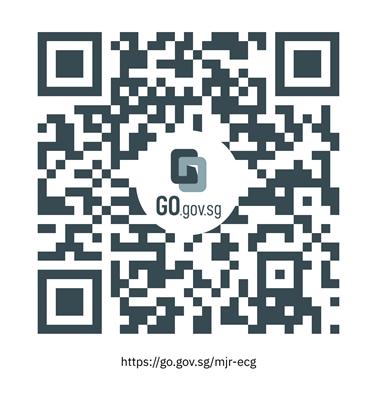
Alternatively, you can book an appointment at https://go.gov.sg/mjr-ecg or scan the QR code below.
24hrs Contact Numbers
Some useful 24hrs contact numbers provided by REACH (a mental healthcare service set up to work closely with schools) to help students with emotional, social and/or behavioural issues are as follows:
SOS : 1800 2214444
SAMH : 1800 2837019
How can Counselling Help?
Through the counselling process, we will seek to discover, assess and understand the issues, problems and concern student are experiencing and to explore how we can address them effectively. Counselling utilize professional Knowledge and therapeutic skills as tools to achieve the counselling goals set jointly by both the student and the counsellor.
Counsellors are NOT here to:
• Analyse and interpret the student's situation
• Solve problems
• Tell students what to do
• Make students dependent on them
• Give a pep talk
Counsellors are here to:
• Explore difficulties
• Clarify Conflicting issues
• Discover alternative ways to manage situations
• Allow students to decide course of action that will help
• Help students help themselves
Responsive Services
The school counsellors responsive services are as follows:
Counsellors provide individual and small-group counselling to Students, and where appropriate, consult with relevant school personnel regarding students being counselled.
Work with families of Students being counselled, and conduct home visits.
Refer Students and their families to community resources for specialized assistance.
Provide regular feedback, within the boundaries of confidentiality to the school administration and teachers concerned on the work done with the Students being counselled.
Provide educational and career counselling to Students.
Counsellors also conduct Talkshops, Workshops and Parents’ consultation and talks.
Presenting Issues
Examples of counselling case are as follow:
Emotional & Behavioural Difficulties (EBD)
Anger Issues
Grief / Loss
Relationship Issues: Peers ,Boy-Girl, Family, Teachers
School Refusal
Truancy
Abuse: Emotional, Physical, Sexual
Anxiety Disorder
Depression
Obsessive Compulsive Behaviour
Anti-Social Behaviour
Bully
Parenting Tips
Here is what our students need: Love, Limits, and Letting go.
Many students experience the negative effects of excessive parental attention.Parents coddle teenagers and this may stifle their self-esteem and natural talents. As a result, students may grow up with a lack of confidence to face pressures in the real world.
An example of how parents can allow their children to develop decision-making skills is in the selection of subjects at the end of Secondary 2. Here is what we can practise.
Parents can encourage their Kid to do their own subject selection. Parents may want to ask their kids to seek clarification from their teachers and school counsellors. Be there to discuss the option and let them know that the choice they make should serve their needs. Tell them that secondary school is the time for them to continue to learn to pick themselves up when things go wrong, learn from the experience, and move on. As a parent, we can tell them that at their age, they need to take these opportunities to learn, grow, change and at the same time be mindful of the dangers and distractions in today’s world. Hence the need for LIMITS . Tell them how much you believe in them and LOVE them, and prove it by practising the art of LETTING GO . This does not mean going away; it means responding to their needs appropriately, respectfully and non-intrusively.

Useful Contacts
Organisation | Telephone Numbers | Operating Hours |
|---|---|---|
Addiction Helplines Community Addiction Management programme (CAMP) | All Addictions Helpline 6-RECOVER (67326837) Gambling Helplines 1800-X-GAMBLE (1800-9-426253) 1800-6-668-668 | Mon – Fri (8.30 am to 6 pm) |
Beyond Parental Control | 6435 5107 | |
Crisis Helpline Samaritans of Singapore (SOS) |
|
|
Children, Youth, Parents & Family Audible Hearts (Supported by HPB) Family Service Centre (National) | An anonymous online peer support network by youth for youth 1800 838 0100 | Mon-Fri (9am to 5pm) |
Parentline | 6299 8811 | Mon-Fri (9am to 5pm) |
Counselling and Care Centre | 6536 6366 | Mon-Fri (9am to 5pm) |
Shan you Counselling Centre | 6741 9293 | Mon-Fri (9am to 6pm) |
WINGS Counselling Centre | 6383 5745 | Mon – Thur (8.30am to 5.30 pm) |
Helpline for Mandarin Speakers Care Corner 800 Mandarin Hotline | 1800 353 5800 |
(10am to 10pm) |
Learning Challenges and Special Needs Dyslexia Association for Singapore (DAS) Society for the promotion of ADHD Research and Knowledge (SPARK) | ||
Pregnancy Crisis Service | 6339 9700 | |
Psychiatric Help Child Guidance Clinic (CGC) Institute of Mental Health Emergency Help Line Mount Elizabeth Behavioural Health Services Singapore Association for Mental Health Helpline | 6435 2200 6435 3878 6389 2222
| Mon to Fri Daily (24 hours)
|
Manjusrians' Experience in Counselling
Below are the feedback shared by some ex- and current Manjusrians from different levels and streams on their experience in counselling (permission has been given by the students to publish their comments but names and class are not reflected due to confidentiality)
“I learn a lot from counselling. I learn to stretch and push myself and a lot of positive things.Counselling is actually not that painful experience. It helps students to express ourselves freely and easily“
“When I feel stress or unhappy, I need a person to talk to but every time I can’t find a person…but I heard from other people about counselling. After counselling, I feel better and have changed my life too”
“I will go counselling room if I have problems to say out my feeling… and it makes me feel better after a talk”
“Counselling helps me solve certain problems that can’t be solved by myself”
“A caring and unselfish counsellor who goes all the way to help me to get out of my darkness path and saved my life”
“Counselling makes me feel relaxed and relieved. It is a place where I can forget everything and know myself well”
“I feel relaxed because I’ve got someone to talk to and not fear other people will come to know about it”
“The school counselor is very good. She helps me a lot. Look for her if you need help.
“First time is kind of weird but after a few times, I find counselling to be helpful”
“Counselling works for me. After counselling, I tried out what the counsellor suggested and change happened”
“Counselling sometimes can be scary for me because I'm afraid of being judged after sharing my thoughts and feelings. However, after each session, I find counselling to be beneficial”
“I learned how to schedule my plans and change my attitudes. Can easily speak to the counsellor about heart problems, at least we don't need to keep our problems in our hearts. Sharing our thoughts and ideas are ok and good”
Recommended Books
(Books can be borrowed from the National Libraries or purchase from major bookstores. The list will be updated whenever there are new recommendations)
For Students :
How to take the grrr out of anger by Elizabeth Verdick & Marjoire Lisovskis
Good and Mad : Transform anger using mind, body, soul and humour by Jane Middelton-Moz, Lisa Tener & Peaco Todd
How to control your anger before it controls you by Albert Ellis
Fighting the invisible tigers : a stress management guide for teens by Earl Hipp
Loving what is : four questions that can change your life by Byron Katie
Question your thinking, change the world by Byron Katie
Change 101 : a practical guide to creating change in life or therapy by Bill O Hanlon
The hidden messages in water by Masaru Emoto & translated by David A Thayne
The last lecture by Randy Pausch
Tuesdays with Morrie by Mitch Albom
Change your mind, change your life by Gerald G Jampolsky M.D & Diane V Cirincione
Making the brain body connection : a playful guide to releasing mental, physical & emotional blocks to success by Sharon Promislow
Stress can really get on your nerves! by Trevor Romain & Elizabeth Verdick
The little book of coaching by Ken Blanchard
Do one thing different by Bill O Hanlon
The language of choice theory by William Glasser
For Parents :
Bully-proof your child by Lim Kok Kwang PhD
Do one thing different by Bill O Hanlon
Loving what is : four questions that can change your life by Byron Katie
Question your thinking, change the world by Byron Katie
Change 101 : a practical guide to creating change in life or therapy by Bill O Hanlon
The hidden messages in water by Masaru Emoto & translated by David A Thayne
Change your mind, change your life by Gerald G Jampolsky M.D & Diane V Cirincione
Making the brain body connection : a playful guide to releasing mental, physical & emotional blocks to success by Sharon Promislow
The don't sweat guide for parents : reduce stress and enjoy your kids more by the editors ofDon't Sweat Press
Don't sweat the small stuff for teens : simple ways to keep your cool in stressful times by Richard Carlson
Don't sweat the small stuff with your family : simple ways to keep daily responsibilities and household chaos from taking over your life by Richard Carlson
Don't sweat the small stuff at work by Richard Carlson
For parents and teenagers : dissolving the barrier between you and your teen by William Glasser
Raising a responsible child by Dr Don Dinkmeyer & Dr Gary D McKay
Take back your kids by William J Doterty PhD
Unhappy teenager : a way for teachers and parents to reach them by William Glasser
The language of choice theory by William Glasser
For Teachers :
Smart Moves : why learning is not all in your head by Carla Hannaford
Choice Theory in classroom by William Glasser
Unhappy teenager : a way for teachers and parents to reach them by William Glasser
Don't sweat the small stuff for teens : simple ways to keep your cool in stressful times by Richard Carlson
Don't sweat the small stuff at work by Richard Carlson
Do one thing different by Bill O Hanlon
Loving what is : four questions that can change your life by Byron Katie
Question your thinking, change the world by Byron Katie
Change 101 : a practical guide to creating change in life or therapy by Bill O Hanlon
The hidden messages in water by Masaru Emoto & translated by David A Thayne
Change your mind, change your life by Gerald G Jampolsky M.D & Diane V Cirincione
Making the brain body connection : a playful guide to releasing mental, physical & emotional blocks to success by Sharon Promislow
The language of choice theory by William Glasser
The Quality School by William Glasser
School without failure by William Glasser
The Quality School Teacher by William Glasser